

Google Ads Introduces New Prospecting Features for Display Ads in 2019
Google has announced three prospecting features for Google Display Campaigns that will help business owner and marketers.
Heading into 2019, business owners are just as eager to find news ways to reach potential customers as Google is to find new sources of revenue. Google is constantly updating their ad offerings to provide new ways to connect businesses with their target audience. As the year draws to a close, Google has announced three prospecting features for Google Display Campaigns that will help business owner and marketers.
“With 61 percent of shoppers interested in buying from new retailers during the holiday season, it’s important to make sure your Display campaigns are set up for success through the new year,” the company wrote in a blog post announcing the new features. “To help you maximize your return-on-investment during the bustle of seasonal shopping, we’re sharing three new ways for you to deliver more conversions.”
Google is introducing updates to its Audience Expansion Tool that will help advertisers reach a greater number of people for the same ad budget. This is a great way for businesses to ensure they are getting the best value for their budget. An algorithm will automatically adjust bids to get the maximum reach for their budget. There will be a slider that lets the advertiser decide how tightly they want their original bid amount adhered to. The slider also estimates how much the adjustments will affect the reach.
Beside increasing reach, the Audience Expansion Tool has been shown to increase conversions. According to Google, “advertisers using this tool to improve their Display campaign performance have seen up to 50 percent more conversions for the same investment.”
Google is also launching a feature that creates dynamic product as based on people’s past interactions on Google and publisher sites in Google’s network. This can lead to better ad campaign results because instead of relying on the users’ past interaction with one site, there is data from a much larger base of people. Google will use a machine learning algorithm to create connections between a target audience’s interests that are most likely to generate conversions. In a way, it’s like the “People Also Bought” feature on Amazon, but based on a data from more than one site. This can help business owners if they have a large catalog. This dynamic prospecting can help ensure that a viewer is shown the items in the catalog they are most likely to buy. To enable dynamic prospecting, just link a product feed to a Display campaign in Google Ads.
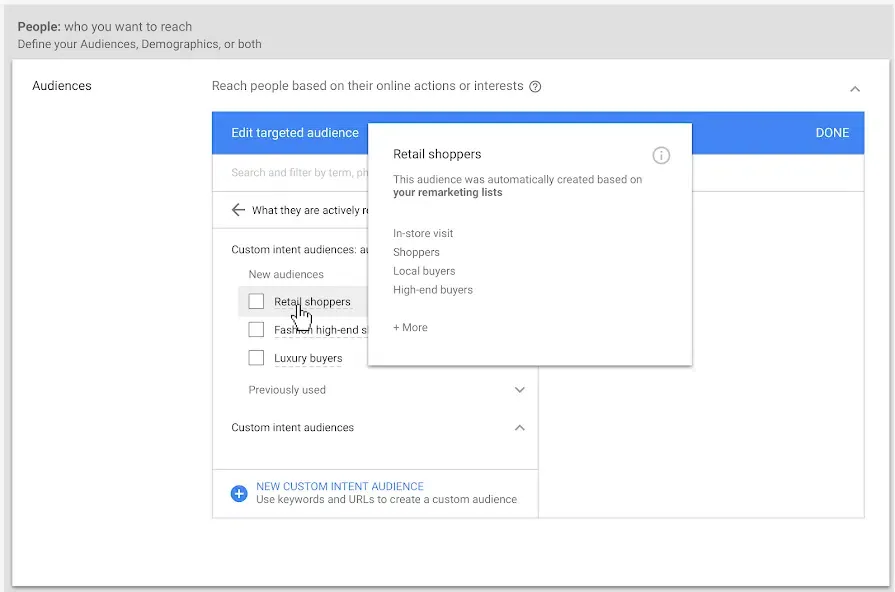
Google is also introducing auto-generated custom intent segments and audiences. Google can automatically create and refresh custom intent audiences based on the most common keywords and URLs in content that people view when looking into a product or service. Like the dynamic product ads, these automatically generated audiences will use data from the entire Google network and not just from the owner’s site.
In a way, the auto-generated custom intent and audiences is the dynamic product ads, but in reverse. Rather than use customers intent and past web traffic to decide which products to show, advertisers can tell Google which products they are trying to sell, and Google will find the best audiences to show the product to. As was stated earlier, this is a huge boon for advertisers who need to manage a large number of products. These automatically generated product ads and audience reduce the need for managing hundreds of keywords and target audiences.
For more recent news about upcoming changes to Google, read this article on Google’s plan to block the ads from sites that use abusive advertising strategies from appearing on Google Chrome.
Quick check
Is your site built for AI search?
Does each service have its own page with the answer up top?
Is your main answer in the first 60 words of the page?
Do your headings match how customers actually search?
Does your site load fast and stay clean on mobile?
Do your pages have schema (FAQ / Article) marking them up?
More on Google Ads & PPC


Built and managed thousands of WordPress, Wix, and Shopify sites, plus hundreds on Squarespace, GoDaddy, BigCommerce, Duda, and Weebly.
